
Have you ever received a message saying “ion know” or “ion care” and paused for a second? 🤔 You’re not alone.
In today’s fast-paced digital world, slang evolves quickly, and “ion meaning in text” is one of the most confusing yet widely used expressions online.
From casual chats to social media platforms like TikTok, Snapchat, and Instagram, ION has become a go-to phrase for millions of users.
But what does it really mean? Is it scientific, slang, or something else entirely? Let’s break it down in a simple, clear, and engaging way.
What Does ION Mean in Text? 🤓
The ION meaning in text is:
ION = “I don’t”
Yes, it’s that simple! In texting and online slang, ION is a shortened, stylized way of saying “I don’t.”
It’s commonly used in informal conversations where speed and simplicity matter.
Quick Examples 💡
- “ion know” → I don’t know
- “ion care” → I don’t care
- “ion want that” → I don’t want that
Why Do People Use “ION” Instead of “I Don’t”? 🤔
Language on the internet is all about speed, identity, and expression. Here’s why “ION” became popular:
- ⚡ Faster typing – fewer characters
- 📱 Casual tone – sounds relaxed and natural
- 🌍 Cultural influence – rooted in spoken dialects
- 🔥 Trendy slang – widely used by Gen Z
People don’t always type the way they speak formally. Instead, they type how they sound in real life.
Origin of ION in Slang 🧠
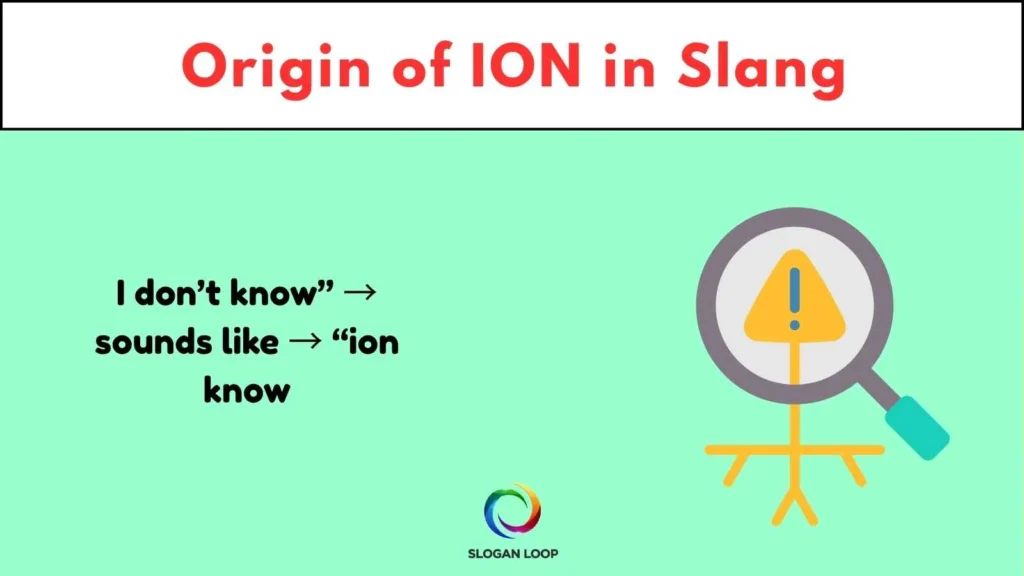
The slang ION comes from the way “I don’t” is pronounced in fast or casual speech.
For example:
- “I don’t know” → sounds like → “ion know”
Over time, this pronunciation became digitized into text form, especially in online communities and social platforms.
“Slang reflects how people actually speak—not how grammar books say they should.”
ION vs Ion (Scientific Meaning) ⚛️
Here’s where things get interesting. The word “ion” also exists in science.
| Context | Meaning |
|---|---|
| Texting/Slang | I don’t |
| Science | A charged particle (atom or molecule) |
So, context matters! If you’re chatting, it means “I don’t.” If you’re in a chemistry class, it’s something entirely different. 😄
How to Use ION Correctly in Text 💬
Using ION is easy once you understand the pattern.
Basic Structure
ION + verb/action
Examples
- “ion like that”
- “ion feel like going out”
- “ion remember”
Notice how it replaces “I don’t” in a sentence.
Common Situations Where ION is Used 📲
You’ll mostly see ION in:
- 💬 Text messages
- 📱 Snapchat & WhatsApp chats
- 🎥 TikTok comments
- 📸 Instagram captions
- 🧵 Twitter (X) posts
It’s rarely used in formal writing like emails or academic work.
Real-Life Conversation Examples 🗣️
Here’s how it appears in real chats:
Friend: “You going to the party?”
You: “ion think so”
Friend: “Do you like that movie?”
You: “ion really like it”
These examples show how natural and effortless it feels in conversation.
ION vs Other Similar Slang 🔍
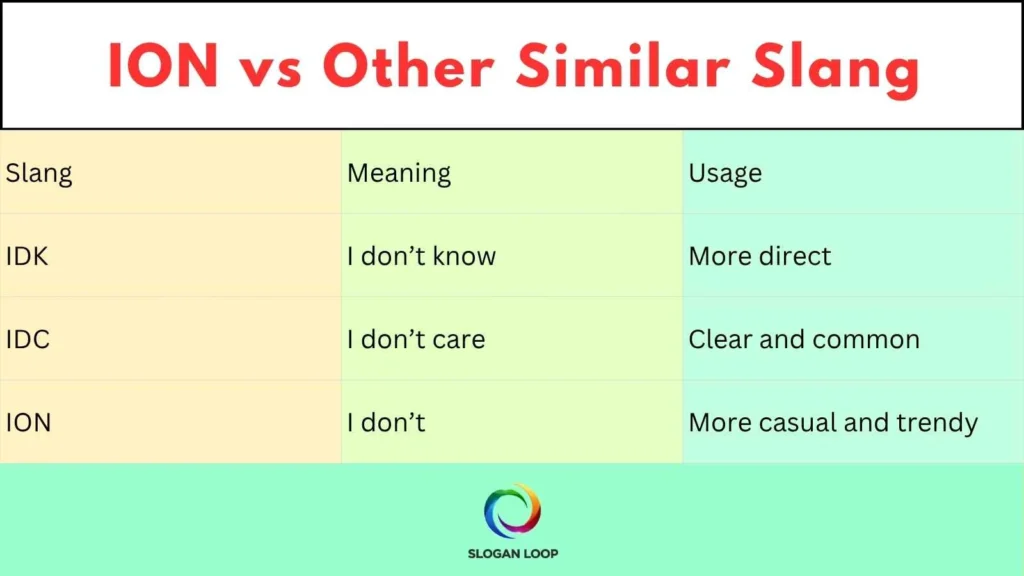
Let’s compare ION with other common abbreviations:
| Slang | Meaning | Usage |
|---|---|---|
| IDK | I don’t know | More direct |
| IDC | I don’t care | Clear and common |
| ION | I don’t | More casual and trendy |
ION is more expressive and conversational compared to traditional abbreviations.
When NOT to Use ION 🚫
Even though it’s popular, avoid using ION in:
- 📧 Professional emails
- 📄 Academic writing
- 💼 Job applications
- 🧑💻 Business communication
In formal settings, always stick with “I don’t.”
Is ION Considered Proper English? 📚
No, ION is not standard English.
It’s classified as:
- ✔ Internet slang
- ✔ Informal language
- ✔ Social media expression
That doesn’t make it wrong—it just means it’s context-specific.
Why ION Became So Popular 🔥
Several trends contributed to its rise:
- 📱 Mobile-first communication
- 🎵 Influence of music and pop culture
- 👥 Peer-to-peer language evolution
- 🚀 Viral social media trends
Once influencers and creators started using it, the slang spread rapidly.
Psychology Behind Slang Like ION 🧠
Using slang like ION helps people:
- 🤝 Feel connected to a group
- 😎 Express identity and personality
- ⚡ Communicate faster
- 🎯 Sound modern and relevant
Language isn’t just about words—it’s about belonging and expression.
ION in Social Media Culture 🌐
On platforms like TikTok, slang evolves daily. ION fits perfectly because:
- It’s short
- It’s relatable
- It mirrors real speech
You’ll often see it in captions like:
“ion even care anymore 😂”
FAQs
1. Does ION always mean “I don’t”?
Yes, in texting slang, ION almost always means “I don’t.”
2. Is ION rude or disrespectful?
Not at all. It’s casual, but tone depends on the sentence.
3. Can I use ION in formal writing?
No. It’s best for informal conversations only.
4. Why do people say “ion know” instead of “I don’t know”?
Because it reflects how people naturally speak quickly in real life.
5. Is ION used worldwide?
Yes, especially among younger audiences on social media platforms.
Final Thoughts
Understanding the ION meaning in text helps you stay updated with modern communication trends. It’s a simple yet powerful example of how language evolves with technology and culture.
To recap:
- ✔ ION = I don’t
- ✔ Used in casual texting
- ✔ Popular among Gen Z
- ✔ Not suitable for formal use
Mastering slang like this not only improves your communication but also helps you connect better in digital conversations. 💬
